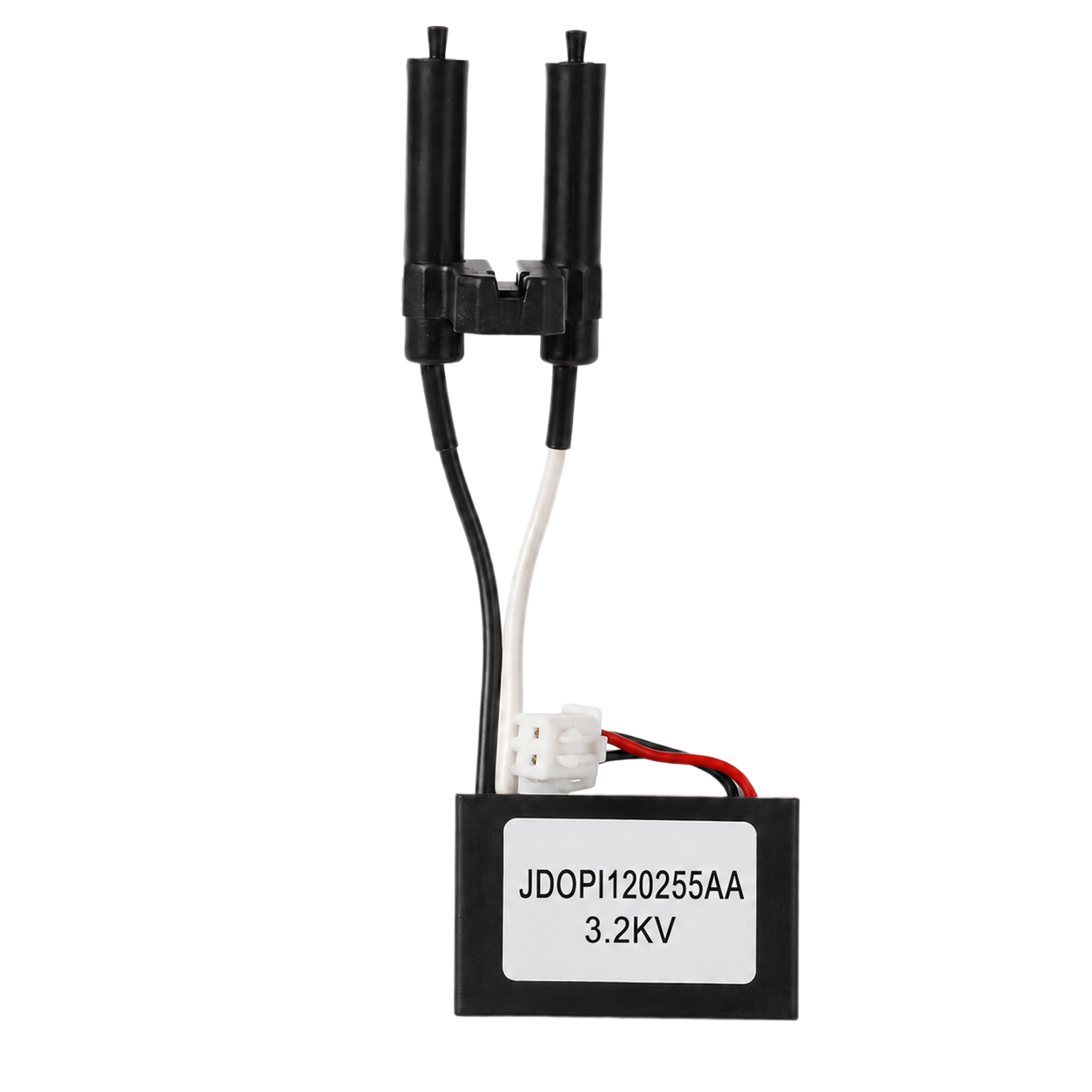
1. Mechanism of Plasma Generation
Similar to negative ions, plasma generators use pulses and oscillators to boost low voltage to high AC voltage. By applying high AC voltage in both the forward and reverse directions to two different electrodes, they simultaneously generate two types of ions: positive ions (H+) and negative ions (O2-); H+ and O2- undergo a chemical reaction on the surface of particles, forming OH radicals, which extract H+ from the proteins of airborne bacteria. This inactivates the bacteria, thereby achieving a bactericidal effect.
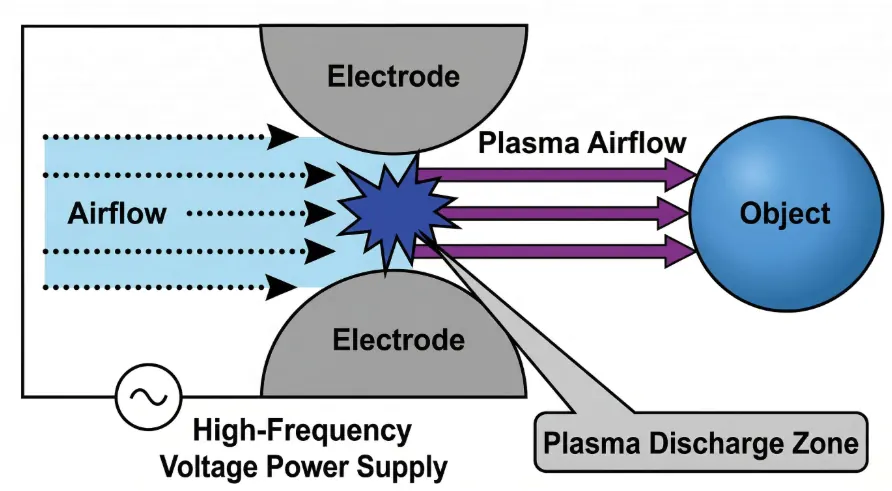
2. Plasma Benefits
Microorganism Sterilization and Inactivation
The hydroxyl radicals and reactive oxygen species in the plasma can destroy the protein structures of airborne microorganisms, such as bacteria and viruses, resulting in effective sterilization and inactivation
Static Electricity Elimination
Plasma can neutralize positive and negative static charges on object surfaces, thereby eliminating static electricity
Odor Removal
The hydroxyl radicals in the plasma can react chemically with odors in the air (such as trimethylamine) and break them down into odorless gases, thereby providing a deodorizing effect
3. Technology Comparison
| Comparison Items | Negative Ion Generators | Plasma Generator |
|---|---|---|
| Operating Principle | A high-voltage DC current applied to the tip of a carbon brush generates a strong corona discharge, rapidly emitting a large number of electrons (e-). Since electrons cannot exist in the air for long (their lifetime is on the order of nanoseconds), they are immediately captured by oxygen molecules (O₂) in the air, forming negative oxygen ions. | By applying alternating high voltage in both the forward and reverse directions to the two different electrodes of the carbon brush, simultaneously generate two types of ions—positive ions (H+) and negative ions (O2-)—on the two different electrodes of the carbon brush; |
| The core substance involved in this process | O2- | H+, O2-, hydroxyl (OH) |
| Benefits to the Human Body | Negative oxygen ions improve lung function, promote metabolism, enhance resistance to disease, and improve sleep | Negative ions in plasma also improve lung function, promote metabolism, enhance resistance to disease, and improve sleep |
| Dust Reduction | Negatively charged anions neutralize the positively charged smoke particles in the air, causing them to settle naturally. | Negative ions in plasma also have a dust-settling effect |
| Mechanism of Bacteria Removal | Negative ions themselves cannot kill bacteria | H+ and O2- undergo a chemical reaction on the surface of particles, forming OH radicals, which extract H+ from the proteins of airborne bacteria. This inactivates the bacteria, thereby achieving a bactericidal effect. |
| Mechanism of Formaldehyde Removal | None | Formaldehyde is degraded and broken down, producing carbon dioxide and water |
| Are there any other functions? | None | Static elimination, odor removal |
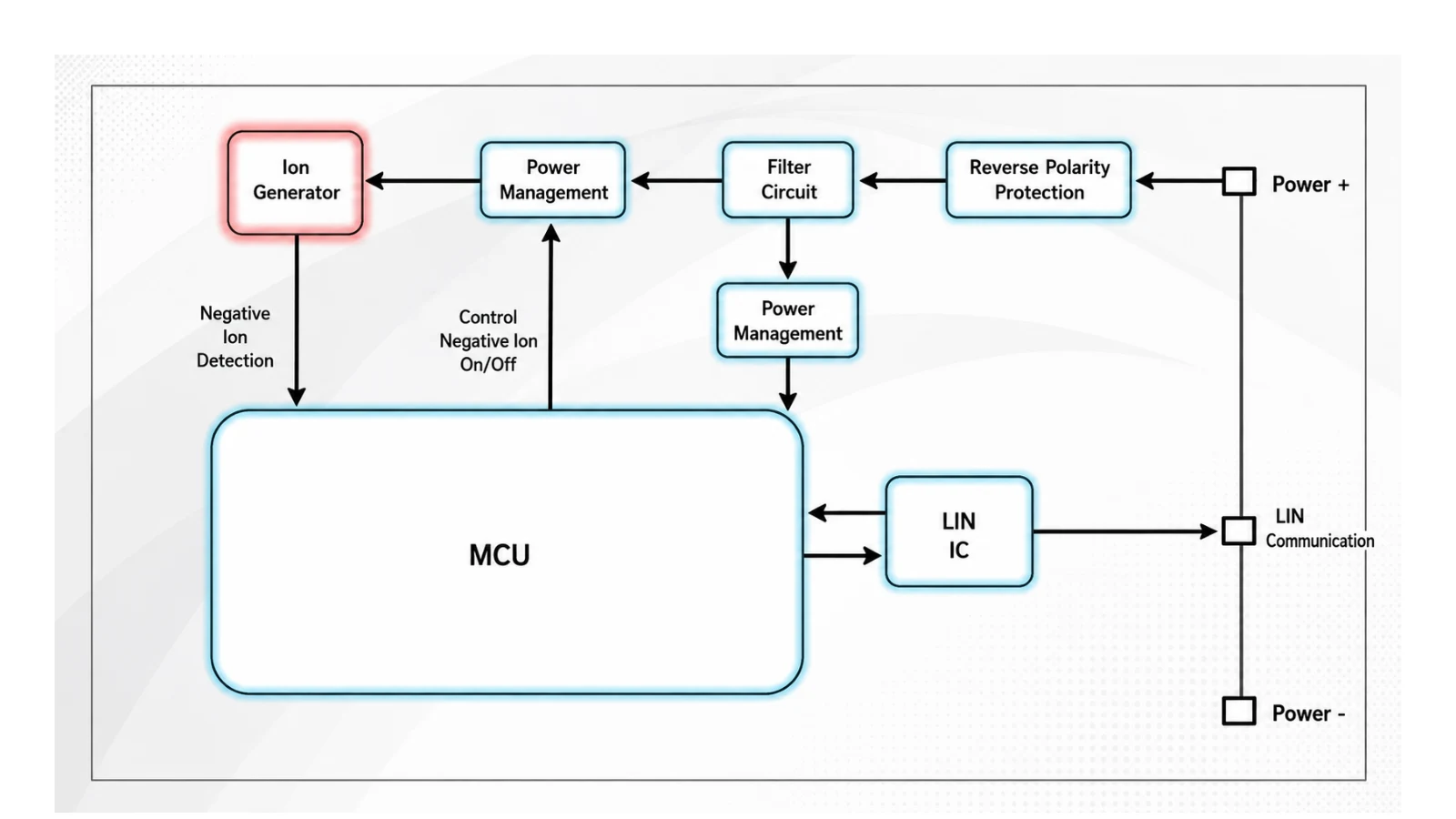
4. Plasma Generator Block Diagram
The positive supply first passes through reverse-polarity protection and the filter circuit. Separate power-management stages then supply the ion generator and MCU. The MCU switches ion generation on or off, monitors the negative-ion detection signal, and exchanges operating commands and status data with the host controller through the LIN IC.
5. Reference Technical Parameters
The following technical parameters apply to a reference plasma-generator configuration. For model-specific values, refer to the selected product datasheet.
| Parameter | Plasma reference specification |
|---|---|
| Rated voltage | 12 VDC |
| Voltage range | 9–16 VDC |
| Operating current | ≤70 mA |
| Standby current | ≤0.1 mA |
| Communication method | LIN communication or hardwired communication |
| Ion concentration | >2 million ions/cm³ at 1 m from the carbon brush with 5 m/s airflow |
| Ozone concentration | <0.045 ppm |
| Operating temperature | −40°C to 85°C |
| Storage temperature | −40°C to 90°C |
6. Performance Test Results
The following bacteria-reduction and PM2.5 removal results were obtained from tested plasma samples under the stated conditions.
Bacteria-reduction test
Test report 2023FM19436R01 records laboratory air-disinfection testing of the M1801 positive-and-negative ion generator against Staphylococcus albus 8032. Testing was conducted in a 1 m³ aerosol chamber at 22.5°C and 64% relative humidity. The module was powered by DC 12 V and operated for 2 hours.
| Trial | Test organism | Exposure time | Bactericidal rate |
|---|---|---|---|
| 1 | Staphylococcus albus 8032 | 2 hours | 67.66% |
| 2 | Staphylococcus albus 8032 | 2 hours | 70.00% |
| 3 | Staphylococcus albus 8032 | 2 hours | 72.68% |
These results apply to the submitted M1801 sample and the stated test conditions.
Test report: View Full Test Report
PM2.5 removal test
In the plasma-sample test, the starting PM2.5 concentration was 2.97 mg/m³. It decreased to 0.88 mg/m³ after 60 minutes, corresponding to a 70.3% removal rate. The CADR was 3.46 m³/h.
| Time | PM2.5 concentration | Removal rate |
|---|---|---|
| 0 minutes | 2.97 mg/m³ | Baseline |
| 10 minutes | 2.33 mg/m³ | 21.5% |
| 20 minutes | 1.86 mg/m³ | 37.4% |
| 30 minutes | 1.53 mg/m³ | 48.5% |
| 40 minutes | 1.26 mg/m³ | 57.6% |
| 50 minutes | 1.05 mg/m³ | 64.6% |
| 60 minutes | 0.88 mg/m³ | 70.3% |
| CADR | 3.46 m³/h | |