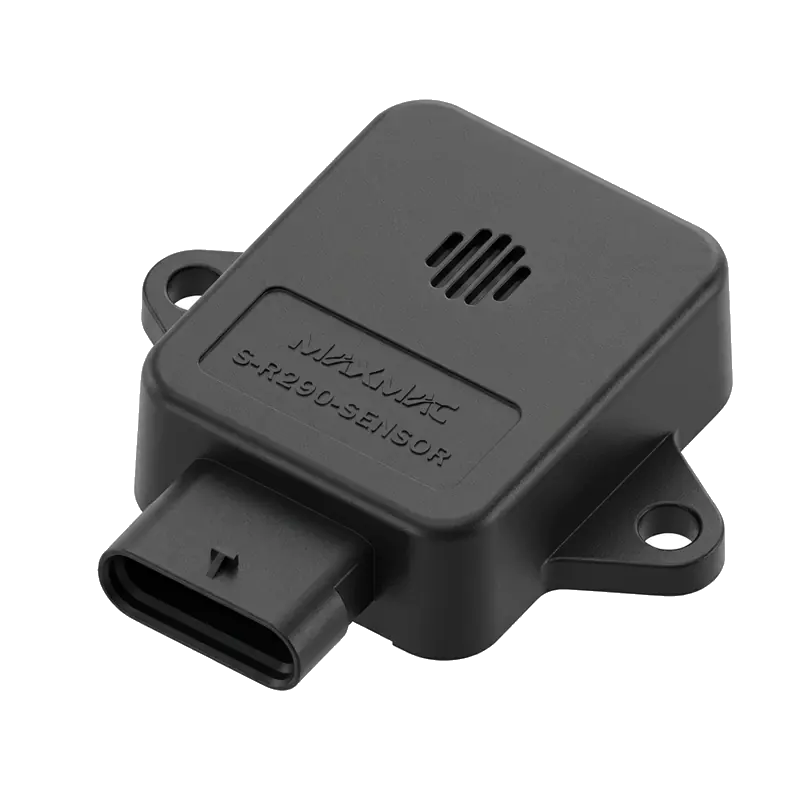
Heat pump and refrigeration system using a MAXMAC R744 CO2 refrigerant leak detection sensor

R744 Refrigerant Leak Detection

R744 Refrigerant Sensor Manufacturer & OEM Supplier

MAXMAC provides highly reliable R744 refrigerant gas sensor solutions and flexible custom integration services for HVAC system manufacturers, industrial refrigeration project integrators, and OEM customers. Designed to detect CO2 refrigerant leaks in harsh transcritical environments, our sensors are produced under quality management systems certified to ISO 9001 and IATF 16949, with testing support from our advanced CNAS-accredited national laboratory. From rapid sample evaluation through high-volume production, we provide comprehensive OEM/ODM technical support to help safeguard your R744 CO2 systems.

PRODUCT OVERVIEW

Dedicated NDIR Detection Sensor for R744 Refrigerant Safety Systems

As an eco-friendly natural cooling agent, r744 refrigerant is increasingly recognized as a mainstream r744 refrigerant replacement option. However, unique r744 refrigerant properties dictate an exceptionally high operating pressure, with transcritical cycles frequently exceeding 100 bar. Even a small pipe crack or loose connection can therefore cause rapid gas dispersion. If a leak occurs inside enclosed equipment or another confined space, a high concentration of carbon dioxide can reduce system efficiency and create an asphyxiation hazard.

MAXMAC develops high-accuracy nondispersive infrared (NDIR) gas sensor modules specifically for HVAC/R applications. The sensor continuously monitors CO2 refrigerant R744 concentration inside the system and sends real-time signals to the main control board, helping the equipment trigger protective measures as soon as a leak is detected, even under demanding environmental conditions.

  1. An optional relay output can be integrated to match the equipment control strategy.
  2. Developed in accordance with EN 14624, the sensor delivers high unit-to-unit consistency and a 15-year service life, with maintenance-free operation and no manual recalibration required after delivery.
  3. An OEM component validated against automotive-grade test requirements for stable operation under extreme environmental and vibration conditions.
MAXMAC R744 refrigerant NDIR leak detection sensor for HVAC/R safety systems
Download Datasheet

TECHNICAL DATA

R744 Refrigerant Sensor Specifications

Detection Performance

Product Name
CO2 (R744) Refrigerant Leak Detection Sensor - R3
Measured Gas
CO2 (R744)
Operating Principle
Non-dispersive infrared (NDIR)
Measurement Range
400-10,000 ppm / customizable up to 50,000 ppm
Resolution
1 ppm
Measurement Interval
4 s
Accuracy
400-3000 ppm: ±(50 ppm + 3% of reading) Other ranges: ±(50 ppm + 5% of reading) or ±5%, whichever is greater
Warm-up Time
≤ 10 s
Response Time
≤ 20 s (τ63%)
Life Expectancy
> 15 years

Operating Conditions

Operating Temperature
0°C to 50°C
Operating Humidity
5%-95% RH, non-condensing
Storage Temperature
-30°C to 70°C

Electrical & Mechanical

Operating Voltage
5.0 VDC / customizable
Current Consumption
Average 16 mA, peak 300 mA (duration <10 ms / sampling cycle)
Dimensions
72 mm × 71 mm × 19 mm
Weight
Approx. 25 g
Interface
RS485 / customizable LIN 2.1 / CAN
NDIR R290 refrigerant gas sensor working principle

TECHNICAL INSIGHTS

Why Do R744 Refrigerant Systems Require High-Accuracy NDIR Detection Technology?

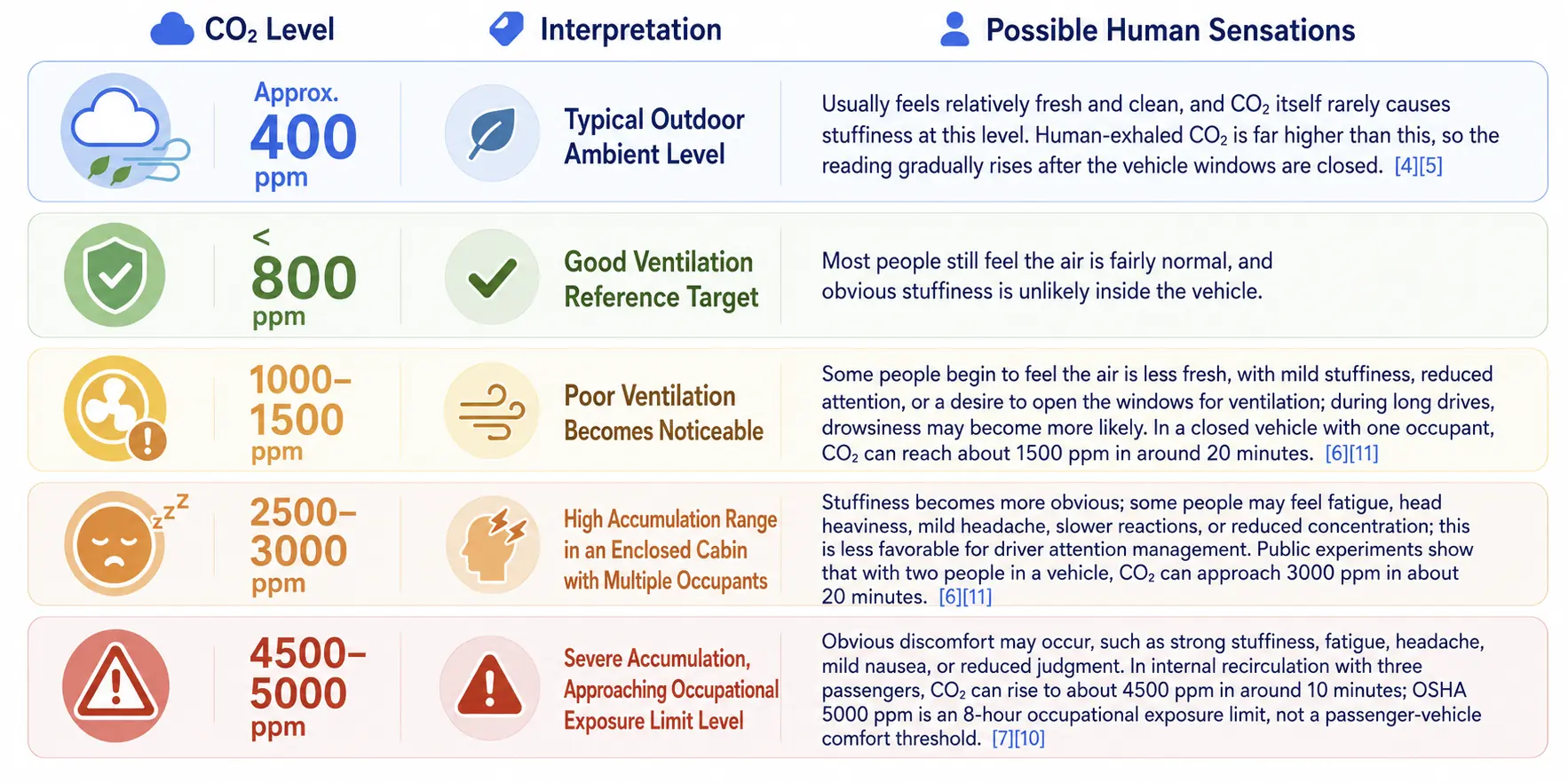
First, r744 refrigerant pressure is extremely high, with system operating pressure typically five to ten times that of conventional fluorocarbon systems. This increases the risk of microleaks at pipe joints and connections. CO2 is also colorless and odorless, so a leak can accumulate rapidly in enclosed locations such as machinery rooms, supermarket cold-storage areas, and vehicle cabins. The NIOSH short-term exposure limit is 30,000 ppm; at higher concentrations, exposure can cause headache and breathing difficulty, while 10% (100,000 ppm) or more can rapidly cause unconsciousness or death. Detecting small leaks of CO2 refrigerant R744 is therefore essential for protecting people and equipment.

Electrochemical and semiconductor sensing elements can be affected by changes in temperature and humidity, resulting in drift, while exposure to high gas concentrations may degrade some sensor materials. By contrast, nondispersive infrared (NDIR) sensing technology measures how CO2 molecules absorb infrared light at specific wavelengths. Because the measurement does not depend on a consumable chemical reaction with the gas, NDIR supports stable, low-drift, high-accuracy monitoring over a long service life with reduced calibration requirements, providing a dependable technical foundation for R744 refrigerant safety systems.

TECHNICAL ADVANTAGES

Powering the Next Generation of Refrigerant Gas Detector Technology

Two-point calibration equipment for eliminating optical chamber deformation error
01

Anti-Deformation Two-Point Calibration

High stability that redefines the infrared refrigerant leak detector

During production-line assembly or in-factory handling, human operation can cause micron-level deformation or displacement in the optical chamber, immediately affecting system accuracy. To address this risk, MAXMAC uses a Two-Point Calibration process: the sensor receives its initial calibration during production, followed by a second calibration of each independent module before shipment. These two controlled stages compensate for subtle mechanical-stress deformation introduced on the production line, helping every delivered module achieve consistent, high-level accuracy.

MAXMAC R744 (CO2) refrigerant sensor samples connected to a portable evaluation system

SAMPLE READY

R744 (CO2) Sensor Samples Ready for Testing

Accelerate your R744 (CO2) refrigerant safety solution development with our ready-to-test sensor samples.

Request samples and evaluation reports to verify performance, reliability, and integration compatibility for your HVAC/R applications.

Contact Us

MANUFACTURING CAPABILITIES

Complete Manufacturing Capabilities for OEM Smart Sensor Production

In-House SMT Manufacturing for Consistent Smart Sensor Quality and Faster Delivery

As a professional Smart Sensor manufacturer, MAXMAC operates its own SMT production area with comprehensive PCB assembly and inspection capabilities. Key processes are completed in-house, including electronic component placement, reflow soldering, AOI inspection, firmware programming and functional testing. This integrated capability accelerates prototyping, pilot production and product iteration while supporting OEM/ODM customization of each air quality sensor module, including sensing combinations, interfaces, PCB dimensions, connectors and firmware logic.

Flexible Production with Full MES Traceability

MAXMAC combines automated production lines with flexible manual assembly to match different IAQ product structures, order volumes and customization requirements. Automated equipment protects consistency and delivery efficiency in volume production, while skilled workstations support complex assembly, pilot runs and customized air quality sensor module configurations.

Every production stage is connected to our MES system, enabling full traceability across material batches, PCB assembly, sensor calibration, firmware programming and finished-product inspection. This complete manufacturing data trail gives OEM/ODM customers dependable quality assurance and supports reliable volume delivery from an experienced Smart Sensor manufacturer.

TESTING & VALIDATION

CNAS-Accredited Laboratory

MAXMAC’s CNAS-accredited laboratory brings product verification closer to our engineering and manufacturing teams, significantly shortening validation cycles and accelerating the transition from design to volume production. By identifying design weaknesses, potential failure modes, and risk-control points at an early stage, our laboratory capabilities help prevent issues before they reach customers or enter mass production.

Comprehensive mechanical, electrical, environmental, gas, and microbiological testing enables us to verify product performance under demanding operating conditions. This evidence-based validation process strengthens product stability, long-term reliability, and quality consistency while giving OEM/ODM customers greater confidence throughout development and delivery.

CNAS accreditation logo

Specialized Laboratory Facilities

  • Mechanical Reliability Testing Laboratory
  • Electrical Performance Testing Laboratory
  • Bacterial Culture Laboratory
  • Microbiological Testing Laboratory
  • Gas Testing Laboratory
  • Microbiological Inspection Laboratory
  • Balance Room
  • Precision Instrument Room
  • Ventilation Ducts Room
  • High Temperature Testing Laboratory
  • Product Aging Testing Laboratory
  • Impact Testing Laboratory
  • Salt Spray Testing Laboratory
  • Cold Chamber Laboratory
  • Vibration Testing Laboratory
Explore Our CNAS Laboratory

TARGET APPLICATIONS

Meeting Cross-Industry Requirements for R744 Refrigerant Gas Monitor Systems

R744 CO2 automotive heat pump and air conditioning system
01

Automotive HVAC/R Systems

As environmental regulations restrict conventional fluorocarbon refrigerants, more new-energy vehicles are adopting efficient, low-carbon CO2 systems. The enclosed passenger cabin places particularly demanding requirements on system safety. Designed for the complex operating conditions of r744 refrigerant in cars, our compact sensor module offers strong vibration and shock resistance together with excellent electromagnetic compatibility (EMC). It integrates easily inside automotive HVAC equipment and provides continuous, rapid, low-drift concentration monitoring to help protect vehicle occupants.

Contact Us
Transcritical R744 CO2 heat pump system
02

CO2 Heat Pump Applications

Transcritical r744 heat pump systems are increasingly used in cold regions and high-temperature hot-water applications. These units are often installed outdoors or in underground equipment rooms, where they face seasonal temperature extremes, high humidity, and vibration. Our NDIR sensor undergoes rigorous high- and low-temperature cycling calibration and uses a durable anti-condensation coating, supporting sensitive detection of early-stage microleaks during long-term, high-pressure operation and helping prevent significant efficiency loss.

Contact Us
Commercial refrigeration cabinets and industrial cold-storage monitoring
03

Commercial & Industrial Refrigeration

Refrigerant monitoring is a critical safety requirement in enclosed locations such as large supermarkets, cold-chain logistics facilities, and industrial machinery rooms. Our module is an ideal sensing core for a wall-mounted or duct-mounted fixed refrigerant leak detector. It provides stable, continuous ppm-level detection, while customizable communication interfaces support seamless integration with central factory alarm buses and automation networks. This flexibility helps customers design industrial safety systems with reference to EN 378 requirements.

Contact Us
FAQS

R744 Refrigerant Sensor FAQ

Why Do Many Infrared CO2 Sensors Drift After Transportation or Installation?

One reason conventional infrared sensors lose accuracy is that mechanical stress during production-line assembly, handling, or transportation can cause micron-level deformation or displacement in the optical chamber.

MAXMAC addresses this risk with a controlled Two-Point Calibration process. The sensor core receives its initial baseline calibration during production, and every independent module undergoes a second precision calibration before shipment. Together, these two stages compensate for small chamber-deformation errors and help maintain strong accuracy consistency across delivered production batches.

How Sensitive Is the Sensor to Early Leaks in High-Humidity Cold Storage or High-Pressure Heat Pumps?

CO2 systems such as an r744 heat pump operate at very high pressure during a transcritical cycle, making early microleaks difficult for low-sensitivity detectors to identify.

During factory calibration, the MAXMAC NDIR module captures more than 100 real concentration points rather than relying on only a few linear reference points. This high-density calibration supports ppm-level tracking across the specified measurement range, including demanding higher-concentration regions. An anti-condensation coating on the optical chamber also supports stable detection in high-humidity cold-storage and outdoor HVAC environments. The module provides rapid leak detection in accordance with its published four-second measurement interval and response specification.

Can You Provide Communication Interfaces for Our System Protocol?

Yes. Equipment manufacturers should not have to redesign a proven main-control circuit solely to accommodate a fixed sensor interface.

MAXMAC provides flexible communication-interface and protocol development. In addition to standard industrial interfaces, our hardware team can customize I2C and RS485 connectivity and develop LIN bus or CAN bus interface options for new-energy vehicles and advanced industrial controls. This approach can reduce redesign work, simplify integration, and shorten the product-development cycle.

Can the Sensor Meet Automotive-Grade or Harsh Industrial Temperature Requirements?

The module is developed for demanding r744 refrigerant automotive projects and industrial fixed refrigerant leak detector applications. Every production module undergoes high- and low-temperature cycling and aging validation before shipment.

The published operating range for the current R3 module is 0°C to 50°C, with a specified life expectancy of more than 15 years. Temperature compensation supports stable concentration output across that rated range. Projects requiring a wider automotive temperature window, specialized enclosure protection, or additional qualification should be reviewed and validated against the final installation requirements.
Can the Module Be Integrated into Commercial or Industrial R744 Refrigeration and Air-Conditioning Systems?

Yes. The module supports modern transcritical r744 refrigeration cold-chain systems and a new generation of commercial r744 air conditioner equipment.

It can be installed in supermarket machinery rooms, commercial air-conditioning equipment, or chiller control cabinets, subject to appropriate placement and system validation. Two-point calibration, temperature compensation, and customizable analog or digital interfaces support accurate concentration signals and integration with mainstream controllers. Final equipment compliance and safety approval remain dependent on the complete system design and applicable project standards.

Does the Module Support Compact, Low-Power Handheld Refrigerant Leak Detectors?

It can be evaluated for a handheld refrigerant leak detector or refrigerant sniffer leak detectors where the module dimensions, measurement range, airflow design, and power budget match the instrument requirements. The current R3 module measures 72 mm × 71 mm × 19 mm and typically draws an average of 16 mA, with a short 300 mA peak during each sampling cycle.

MAXMAC can also support interface and structural integration review for portable-detector projects. The complete handheld instrument should be validated for battery runtime, sampling path, response time, calibration strategy, and thermal stability before production.

What Does Refrigerant Number R 744 Mean?

Under the ANSI/ASHRAE refrigerant designation system, refrigerant number r 744 is carbon dioxide (CO2). R-744 is a natural refrigerant with a listed global warming potential of 1 and ozone depletion potential of 0.

The MAXMAC NDIR module detects the characteristic infrared absorption of CO2 near 4.26 µm. More than 100 real factory calibration points help the sensor track small R744 concentration changes across its specified range, supporting efficient, low-carbon, and safety-focused operation of the finished system.

RELATED RESOURCES

Related R744 Refrigerant Resources

View All
CO2 refrigerant pressure and temperature reference data
Engineering Reference

CO2 Refrigerant Pressure Temperature Chart

A practical reference developed for HVAC/R and automotive heat-pump engineers. The planned chart will organize R744 (CO2) saturation pressure and temperature data across subcritical and transcritical cycles, supporting system design, pressure-component selection, and preliminary microleak assessment.

Download R744 Datasheet
NDIR Fundamentals

How Does a CO2 Sensor Work?

Learn how NDIR sensors use wavelength-specific infrared absorption to measure CO2 concentration for HVAC, industrial, and environmental monitoring.

Application Engineering

Automotive vs Industrial Air Quality Sensors

Review differences in environmental demands, calibration, interfaces, validation priorities, and system integration across automotive and industrial projects.

Provide Your Details for Professional Product Consultation

Our product experts will provide the most suitable air solutions and product recommendations.