

What Makes a Desktop Air Quality Box Smart?
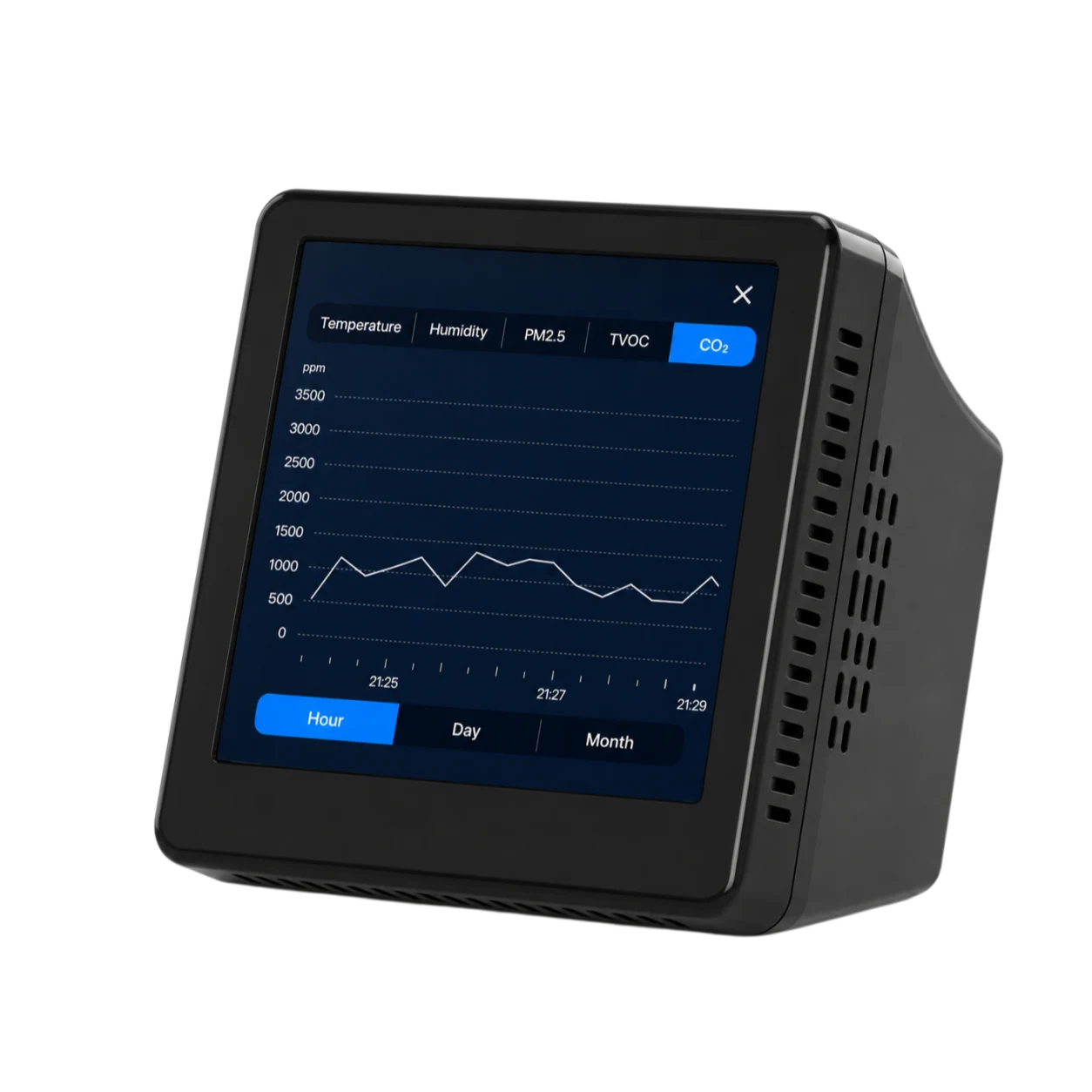
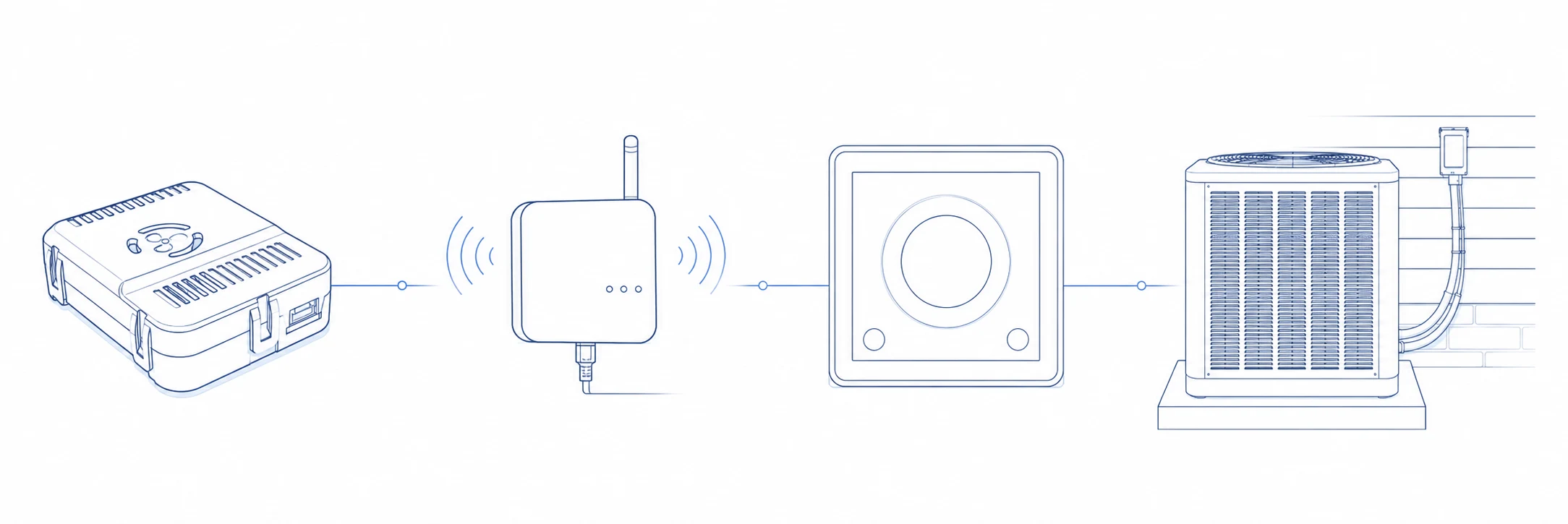
A smart desktop air quality box brings room-side sensing into the HVAC control path. The MAXMAC A56 platform illustrates this architecture with a portable 3000 mAh battery, a four-inch touchscreen and wireless connectivity for flexible placement. Its configurable sensing package covers temperature, humidity, CO₂, PM2.5 and TVOC. WiFi or an expandable field protocol can carry those measurements to compatible air-conditioning, fresh-air and heating equipment. Energy performance depends on this connection. A screen can reveal an uncomfortable or polluted room; a connected controller can translate the same reading into a lower fan command, a temperature setback or a targeted ventilation request. The terminal serves as a room-level input to the wider control system, with its protocol and control sequence defined during project engineering. MAXMAC presents this relationship across its wireless thermostat platform, where the room reading can inform an equipment command.
Five Measurements Give HVAC the Context It Needs
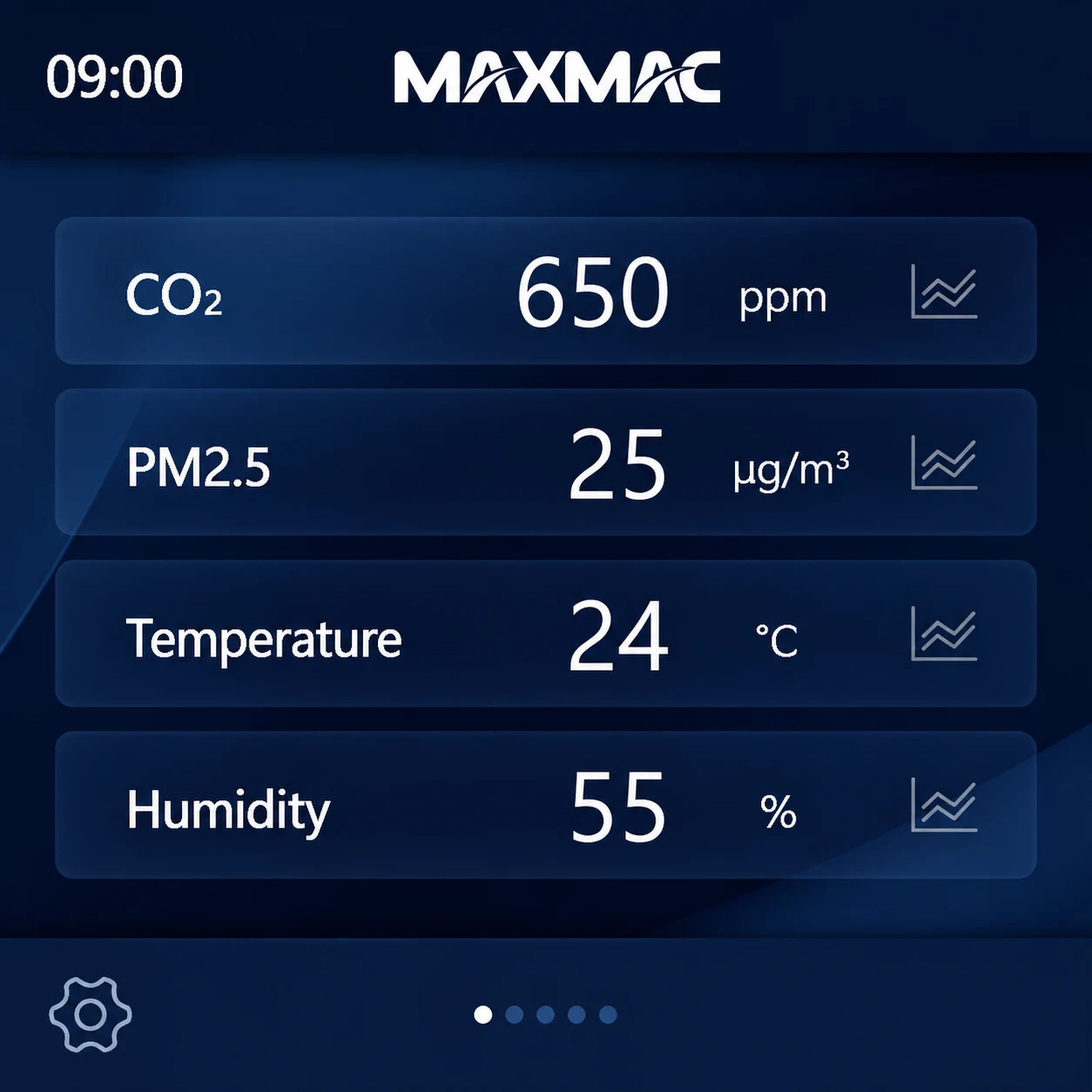
CO₂ provides useful context for occupancy-related ventilation demand because concentrations usually rise as people share an enclosed space. Temperature and humidity keep that ventilation decision aligned with thermal comfort and latent load, since every increase in outdoor airflow can add heating, cooling or dehumidification work. PM2.5 and TVOC add information about particles and volatile pollutants, helping the control strategy choose between outdoor-air ventilation, recirculation filtration and an IAQ alert according to the equipment available. A multi-sensor module can deliver these measurements through one interface, simplifying the path from the sensing board to the host controller. Measurement quality remains central to the result: the enclosure must expose sensors to representative room air, and temperature compensation must address heat from the display, power circuit and sensing elements. The U.S. EPA guidance on indoor air monitors explains that these devices can help identify specific IAQ problems and that performance varies with sensor design and data processing. HVAC energy savings begin when reliable measurements are paired with suitable setpoints and a compatible control sequence.
How Room Data Reduces HVAC Energy Use
The controller compares live room data with comfort targets, IAQ thresholds, schedules and minimum ventilation requirements. It can reduce heating or cooling after the room reaches its setpoint, lower outdoor airflow during periods of light occupancy, or increase ventilation when CO₂ indicates a higher occupant load. Continued sensing shows whether the command produced the intended response and gives the next control cycle an updated operating condition. This feedback loop supports Demand-Controlled Ventilation (DCV), which the U.S. Department of Energy describes as automatic ventilation adjustment based on occupancy or CO₂. A related DOE sensor project reports average DCV energy savings of 17.8% across U.S. climate zones in the cited analysis. The 17.8% figure comes from that DOE analysis. Each project should verify its own savings through measured HVAC energy use. MAXMAC’s demand-controlled ventilation architecture applies the same logic at room level by coordinating IAQ terminals, fresh-air equipment and motorized zone dampers.


Placement and Zoning Determine the Result
Portable desktop placement can bring the sensing point closer to the occupied zone than a central return-air measurement, giving the controller a clearer view of the conditions people experience. Sunlight or a nearby electronic device can warm the enclosure, while supply-air jets and open doors can expose the sensors to air that does not represent the room. The U.S. Department of Energy’s Energy Efficiency and Indoor Environmental Quality Assessment Guide recommends locating CO₂ sensors in occupied spaces and highlights periodic calibration because faulty sensors can undermine DCV performance. Once representative data is available, zoning determines how precisely the system can respond. A single-zone installation may adjust total HVAC output, while a multi-zone design can modulate the fresh-air unit and each motorized damper according to local demand. Wireless communication reduces control-cable requirements for retrofit projects.
Where the Approach Delivers the Most Value
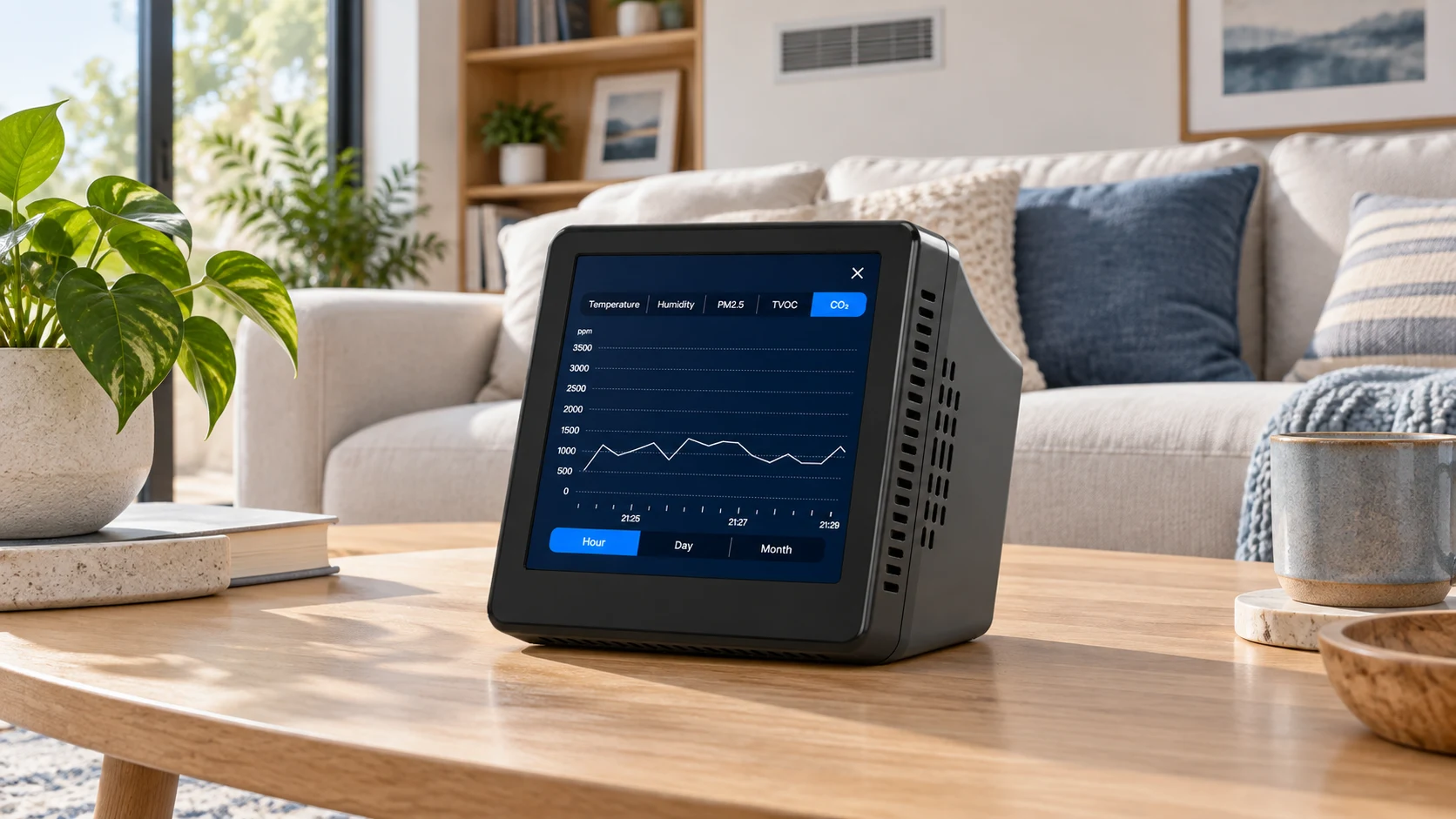
Buildings with variable room use provide the clearest opportunity because their HVAC demand changes throughout the day. Meeting rooms, classrooms, hotel rooms and multi-room homes often operate far below design occupancy for long periods, leaving fixed ventilation schedules to condition more outdoor air than current use requires. A Lawrence Berkeley National Laboratory review of 38 smart ventilation studies found ventilation energy savings of up to 60% without compromised IAQ in favorable cases, while some strategies increased energy consumption. That spread shows why each deployment needs a measured baseline and post-commissioning validation. Teams should compare HVAC runtime and energy use under similar weather and occupancy conditions, then review comfort, CO₂, humidity and pollutant trends before adjusting thresholds. A suitable MAXMAC configuration may use the A56 as a finished desktop interface or place a configurable IAQ sensing module inside an OEM terminal.