1. Why High-Humidity Calibration Is Difficult
Relative humidity expresses the water-vapor pressure as a percentage of the saturation vapor pressure at the same temperature. Near saturation, a small temperature difference can create a large local RH change. Air at 60°C and 95% RH has a dew point of approximately 59°C. A probe surface near or below that temperature can collect liquid water even when the chamber controller remains at its setpoint. Water on a capacitive or resistive sensing layer changes the electrical response and may hold the indicated value close to saturation. The reading can remain high while the deposited water evaporates. The calibration setup therefore needs a known RH value and close temperature agreement between the chamber air, the reference instrument, and the device under test. Probe self-heating also deserves attention because it lowers the RH immediately around the sensing element. Sufficient thermal equilibrium at each point reduces this local bias and makes the comparison representative of the chamber condition.
2. Establishing a Reliable Reference Environment
A laboratory calibration places the device under test beside a traceable reference in a controlled chamber or humidity generator. Their sensing positions should be close enough to experience the same air without blocking flow around either probe. Conditions next to a chamber wall or directly in the inlet jet may differ from conditions in the working volume. A calibrated RH probe can serve as the reference for routine work. Higher-accuracy systems often use a chilled-mirror hygrometer to determine dew point and a calibrated thermometer to determine air temperature; RH is then calculated from those two measurements. Sample tubing needs to remain warmer than the gas dew point so that water does not condense before reaching the reference head. Chamber materials can also disturb stabilization by absorbing moisture and releasing it later. Stainless steel and low-sorption polymers reduce this effect. Use the reference value measured in the working zone during the calibration interval.
3. Selecting Calibration Points and Sequence
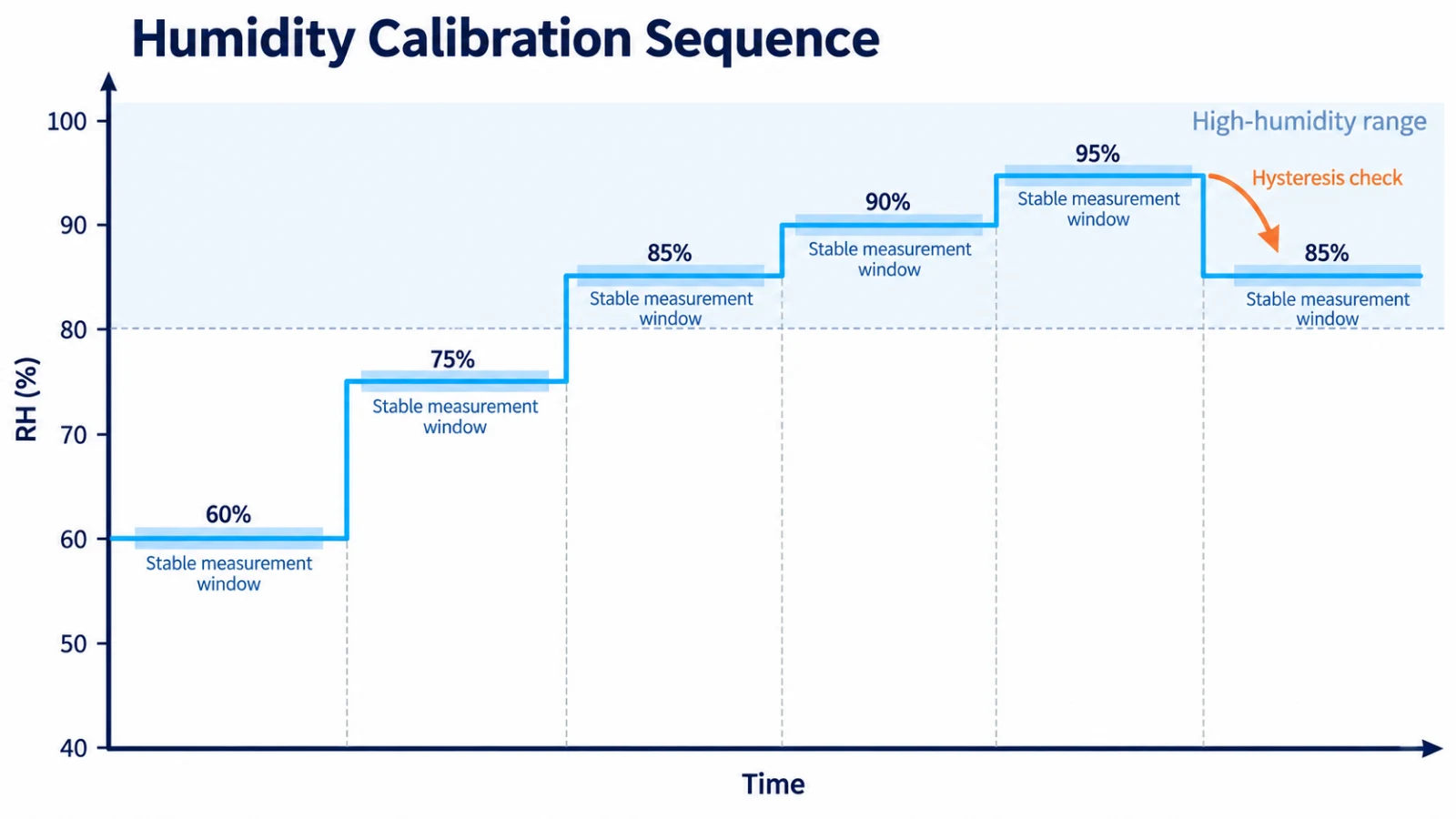
Calibration points should represent the range in which the sensor will operate. A probe used mainly between 80% and 95% RH needs more information in that interval than it gains from evenly spaced points across the full scale. One practical five-point sequence for this application could use 60%, 75%, 85%, 90%, and 95% RH, subject to the product specification and required uncertainty. Moving from the lower setpoint toward the higher setpoints limits abrupt dew-point increases inside the chamber. Data collection begins after both the reference and the device under test meet a defined stability criterion. A fixed waiting time does not prove equilibrium because a protective cap, slow airflow, or moisture stored in the enclosure can delay the response; PTB guidance notes that some arrangements may require at least three hours. After the highest point, returning to a previously measured intermediate point provides a direct check for hysteresis and slow recovery. The difference between the upward and downward readings should remain visible in the calibration record.
4. Using Saturated Salt Solutions
Saturated aqueous salt solutions provide fixed humidity conditions inside a sealed container and are useful when a humidity generator is unavailable. The equilibrium value depends on the salt and the solution temperature. Around 25°C, sodium chloride produces approximately 75.3% RH, potassium chloride approximately 84.3% RH, and potassium sulfate approximately 97.3% RH. The table shows why potassium sulfate is often considered for a near-saturation check. The solution must contain some undissolved salt so that it remains saturated, and the sensor must stay clear of liquid and droplets on the container wall. Temperature uniformity remains essential because the solution value changes with temperature and a cooler probe can still collect condensation. A freshly prepared system may take many hours to equilibrate. Salt solutions work well for intermediate checks and for detecting a large sensor offset. A traceable calibration with a small uncertainty normally uses a calibrated reference instrument in a characterized chamber or generator.
| Saturated solution | Approximate RH at 25°C | Typical role |
|---|---|---|
| Sodium chloride | 75.3% RH | Mid-to-high humidity check |
| Potassium chloride | 84.3% RH | High-humidity check |
| Potassium sulfate | 97.3% RH | Near-saturation check |
5. Evaluating and Verifying the Results
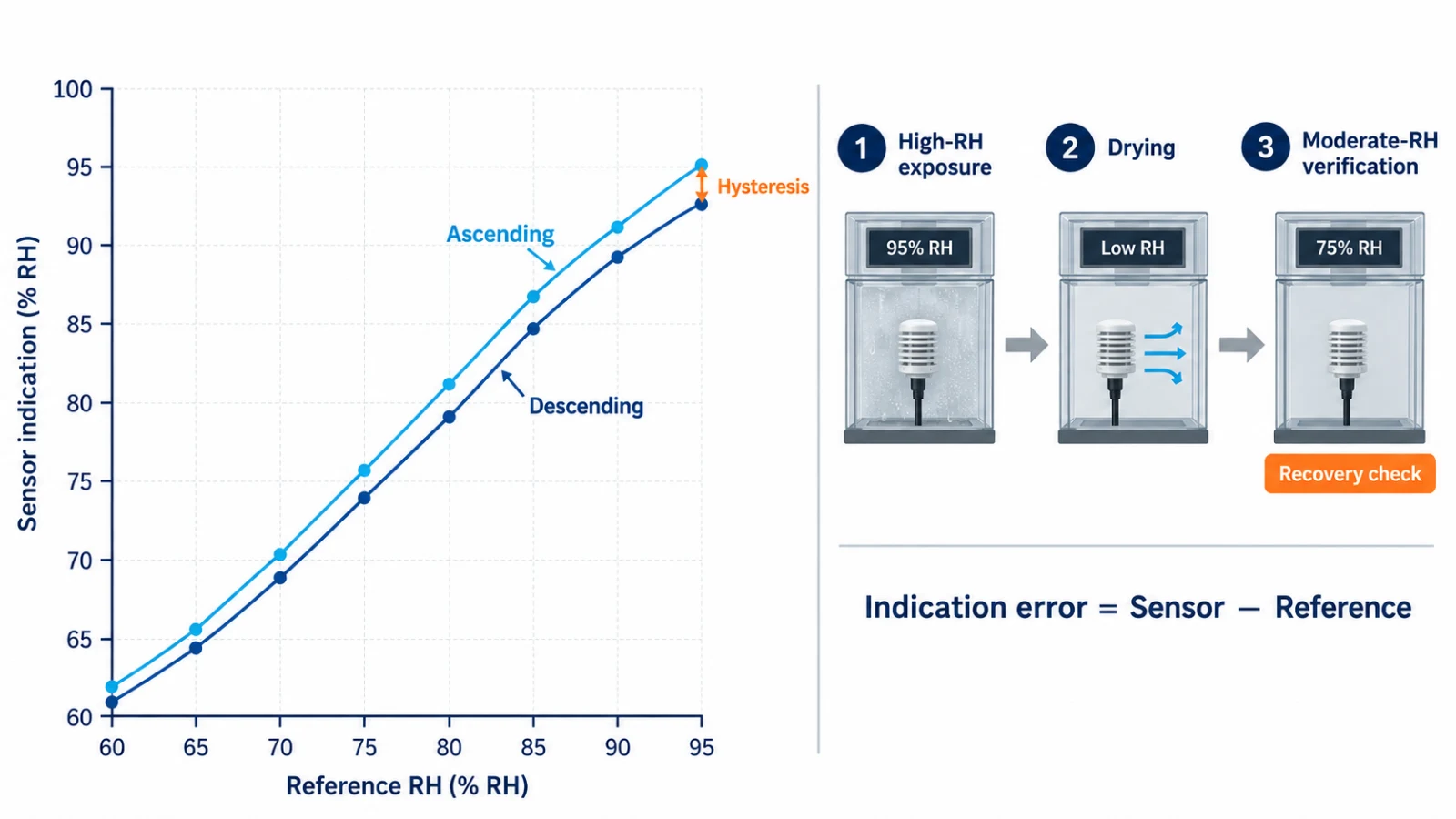
At each calibration point, the indication error is the sensor reading minus the reference value. Repeated readings show whether that error is stable during the measurement interval. Measurements at different positions establish how uniform the chamber is, while repeated runs show how well the sensor reproduces its response. An upward and downward visit to the same RH point reveals hysteresis. Historical calibration records show whether the error is drifting over time. These observations form the evidence used to estimate the uncertainty assigned to the reported correction. A sensor exposed to condensation should be checked again at a moderate RH after it has dried, since an immediate post-exposure reading may reflect temporary water retention. Persistent deviation may require adjustment or replacement. Some polymer sensors have manufacturer-defined reconditioning procedures that use controlled drying and rehydration. Those procedures apply to specified sensor materials and packages, so the relevant product documentation governs the treatment. A final verification run confirms whether the sensor meets its acceptance limit across the intended high-humidity range.
References
- PTB / DKD-R 5-8 — Calibration of Hygrometers for the Direct Measurement of Relative Humidity
- NIST — Hygrometers
- Vaisala — Measuring Humidity in Condensing Environments
- Fluke — How to Calibrate a Hygrometer
- NPL — The Beginner’s Guide to Humidity Measurement
- Greenspan — Humidity Fixed Points of Binary Saturated Aqueous Solutions
- ASTM E104-20 — Standard Practice for Maintaining Constant Relative Humidity by Means of Aqueous Solutions
- Chen and Chen — Determination of Optimal Measurement Points for Calibration Equations
- Sensirion — Humidity Sensor Contamination Guide